Most villa owners think of rain as something that lands on the roof. The floods of December 2025 were a reminder that the bigger problem can be water that fell somewhere else entirely, and arrives at your gate at speed.
November is the time to look at this, before the heavy rain.
What the December 2025 floods showed
Cyprus Mail reported on 9 December 2025 that severe floods had hit the north, with homes and businesses left "under feet of water", roads submerged and reservoirs overflowing. One man died. In the Kyrenia district, the paper reported landslides in the area of Bellapais and Kazafani. The motorway between Morphou and Nicosia was closed for a number of hours. The paper also noted that the northern sector of Ayios Dhometios in Nicosia is built on former streambeds.
The most useful line for a villa owner came from the Mayor of Kyrenia, Murat Şenkul, who said the problem was not the amount of rain falling on the towns but the heavy rainwater coming down from the mountains.
Cyprus Mail gave no rainfall figures for the event, so we will not quote any.
Two other reports are worth mentioning, with a caution. Cyprus FAQ, a news site, carried an undated report of a heavy downpour in Alsancak and Lapta, with houses and roads flooded, the main Lapta to Alsancak road closed towards Kyrenia and the pedestrian underpass on the Kyrenia to Alsancak ring road shut because of flooding. A separate undated Cyprus FAQ piece reported the Kyrenia mayor warning of landslides and rockfalls on the old Doğanköy to Kyklades road. Because neither is dated, we treat them as indicative of what can happen, not as a record of one particular storm.
Why a villa floods when the roof is perfectly sound
Water takes the quickest route downhill and does not care where your boundary is. A few things make that worse.
Hard surfaces such as paving, driveways and concrete terraces stop water soaking in, so it arrives at the lowest point faster and in greater volume. Walls and raised terraces can act like small dams. A dry stream bed that looks like a feature of the garden in August can carry a serious flow in December. And a plot that has been regraded over the years may now send water towards the house where it once sent it past.
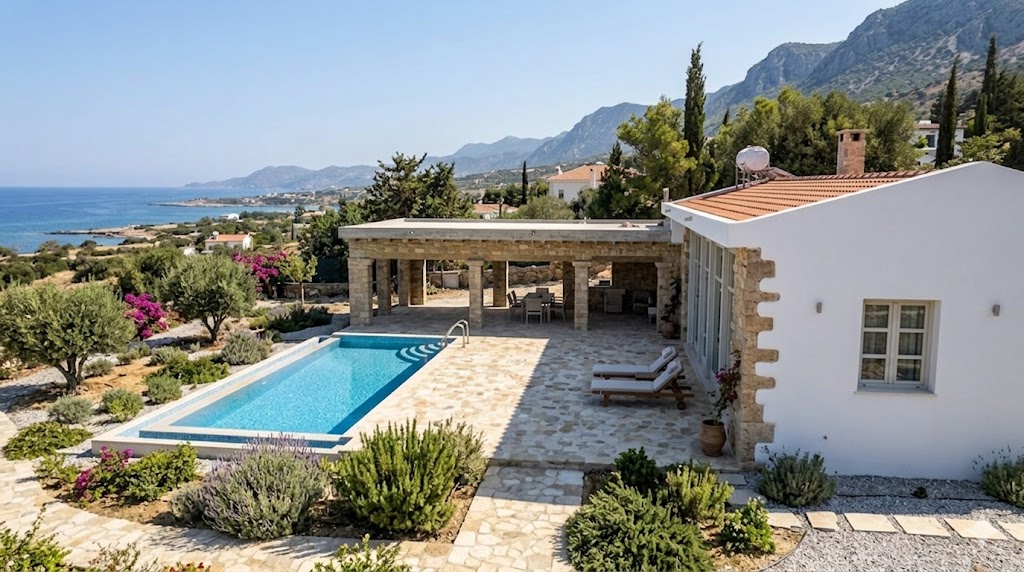
In hillside areas around Kyrenia, Bellapais, Lapta and Esentepe, the slope above the property matters as much as the property itself.
Five places water gets into a villa
1. Thresholds and door levels. If the finished ground outside is close to, or above, the internal floor level, a few centimetres of standing water is enough. Falls on terraces and paths should lead away from the building, not towards it.
2. Retaining walls with nothing behind them. A retaining wall holds back soil, and wet soil is much heavier and pushes harder than dry. Walls need free-draining material and outlets so that water pressure cannot build up behind them. A wall with no drainage that is fine in summer can be the first thing to move in a wet winter.
3. Blocked drains, grates and channels. The Fire Department's guidance, as reported by Cyprus FAQ in November 2025, begins with keeping grates, drains and drainage systems clean. It is the cheapest job on any list. Cyprus FAQ states that its articles are produced with AI assistants, so check the wording against the official source if you plan to rely on it.
4. Basements and lower levels. The same guidance says to check that drainage pumps in basements are working. If you have a lower-level room, a garage below the road or a pool plant room, test the pump now and not on the night.
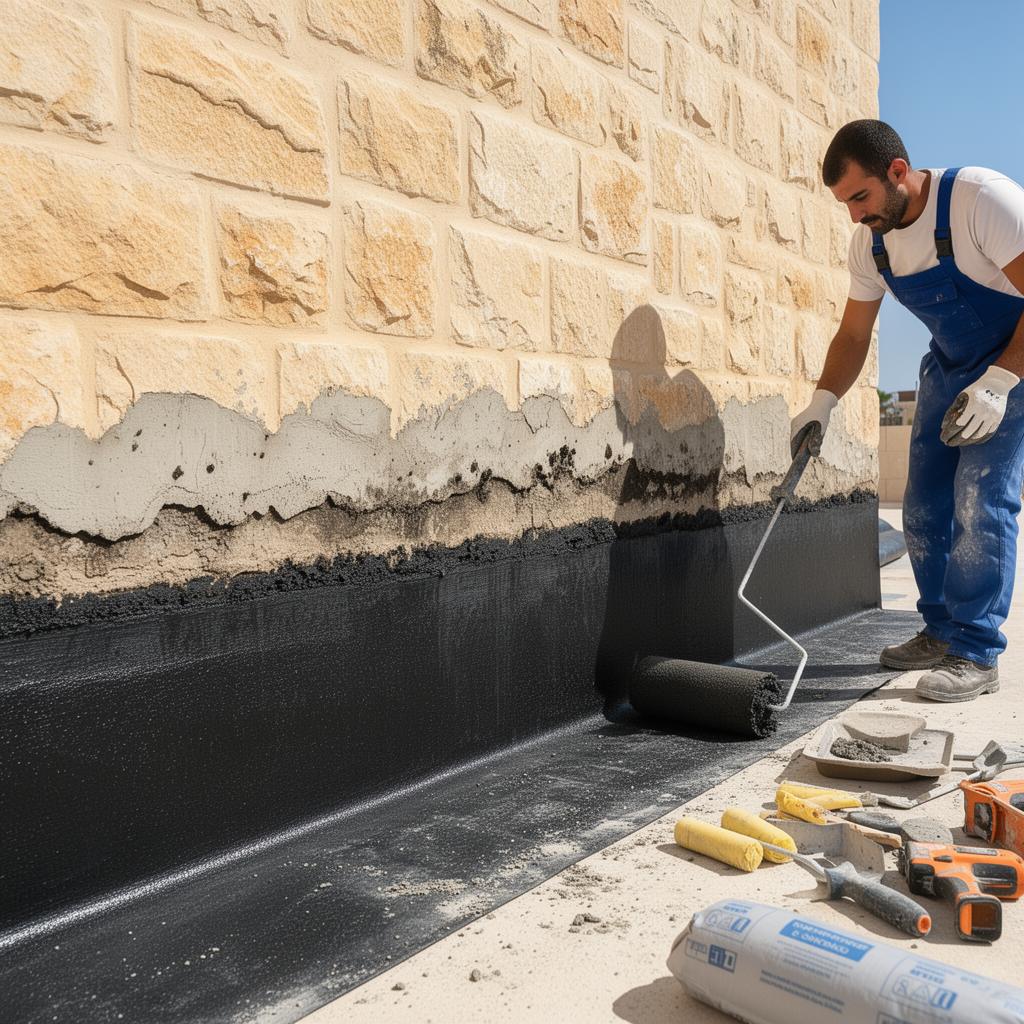
5. Cracks, joints and old waterproofing. The guidance also advises repairing circular stains or colour changes on walls straight away, because they may indicate leakage. Flat roofs, terraces, window and door junctions and the base of external walls are the usual culprits.
Hillside plots and ground movement
If your villa sits on a slope, or below one, look for the early signs: new cracks in paving or steps, a wall that has begun to lean, soil slumping behind a retaining wall, damp patches or seepage at the foot of a wall, or doors and windows that have started to bind. None of these is proof of a problem, and all of them are worth having looked at by a competent person before the rains arrive. Where slope stability is in question, an engineer's opinion is the right first step, and a builder who tells you otherwise is guessing.
Don't make it worse
If you are landscaping, paving or building a wall this winter, keep a simple rule in mind: the water that reaches your plot has to leave it somewhere. Do not block or build over a natural watercourse, do not simply push your water onto a neighbour's land, and keep channels and culverts clear. Where possible, use surfaces and soakaways that let water soak into the ground. Check what permissions apply before you start.
A November checklist
- Walk the plot in the first heavy rain and watch where the water actually goes.
- Clear gutters, downpipes, gullies, grates and channels of leaves and debris.
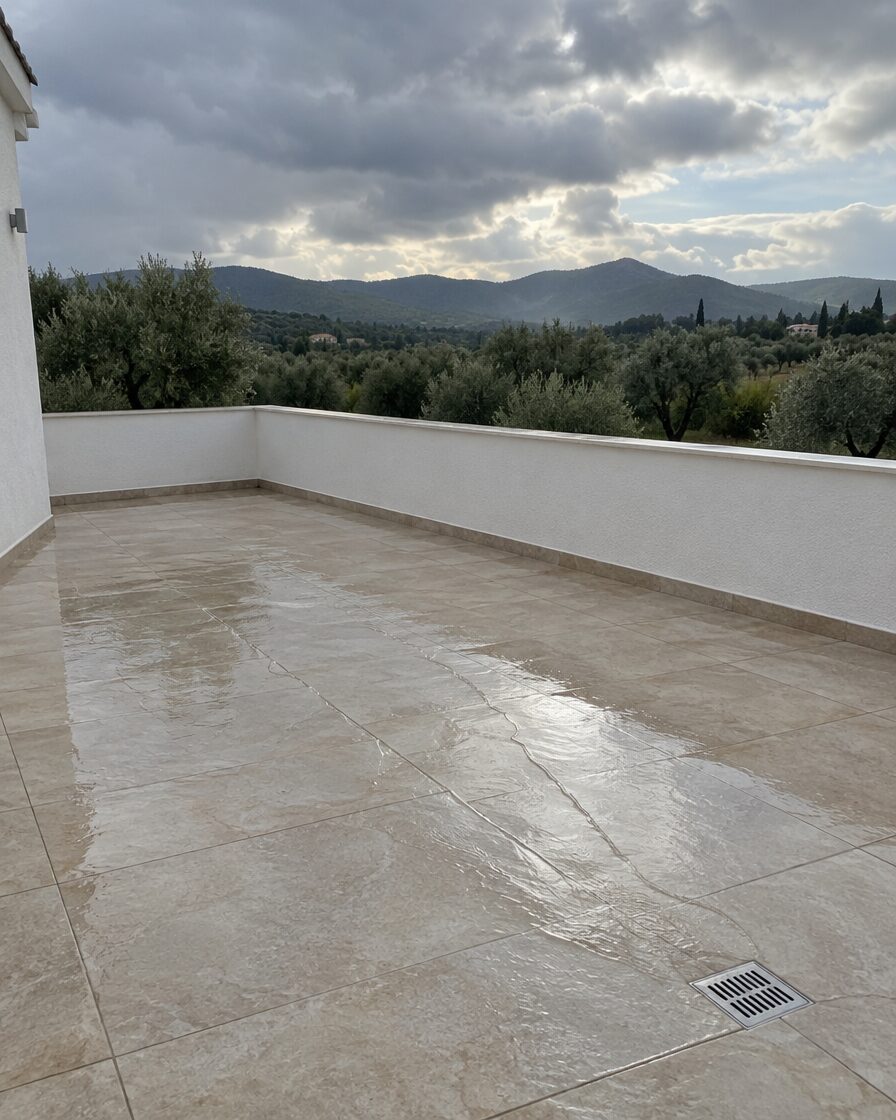
- Check that terraces and paths fall away from the house.
- Look at the base of external walls for damp, staining or flaking paint.
- Check retaining walls for cracks, lean and blocked outlets.
- Test any basement or sump pump.
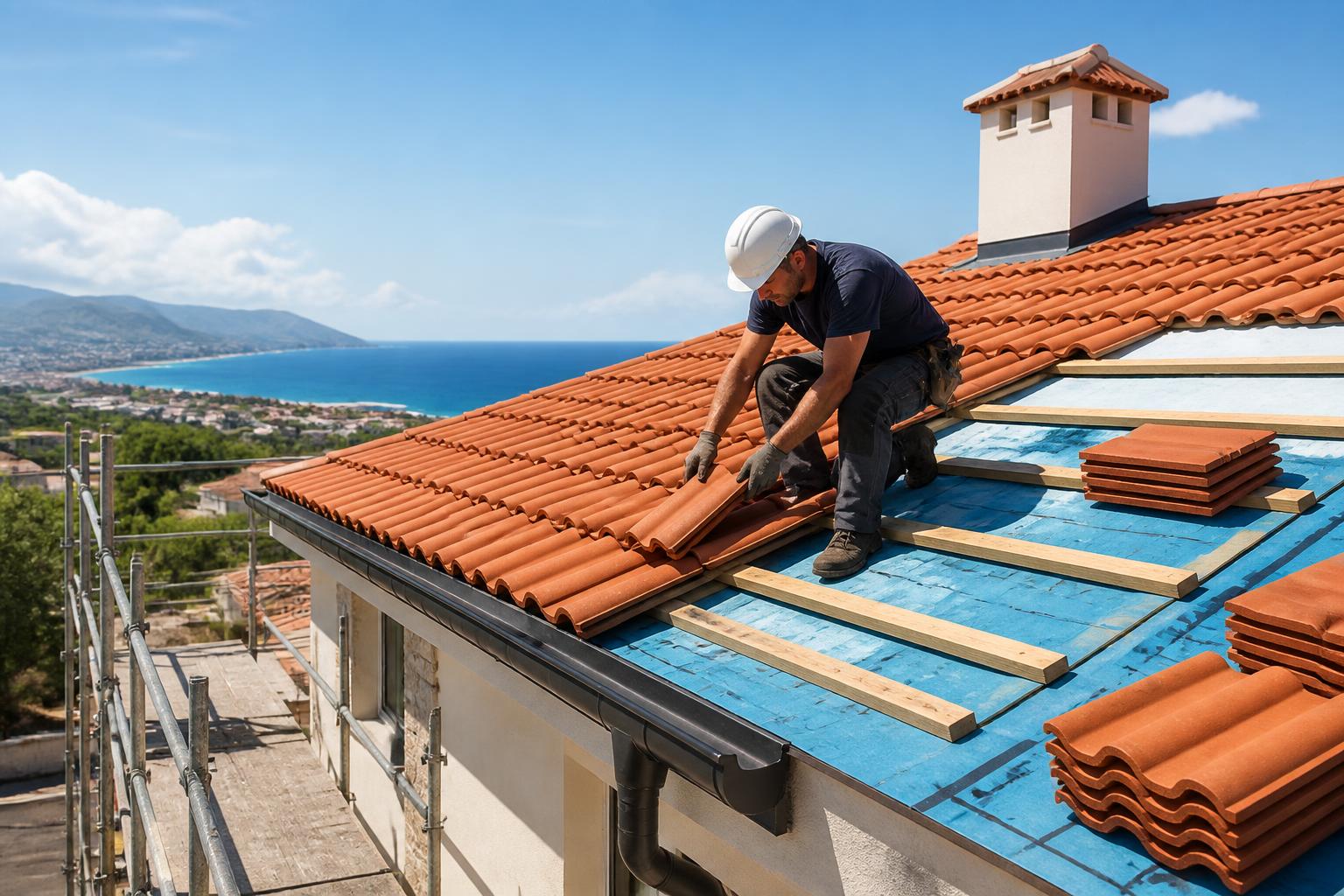
- Check flat roof and terrace waterproofing, upstands and drain outlets.
- Make sure doors, windows and sliding door tracks drain properly.
- Move valuables, stored paint and electrics off floor level in lower rooms.
- Keep sandbags or similar to hand if your plot has flooded before. The Fire Department guidance reported by Cyprus FAQ lists them.
- If the villa will be empty, ask someone to look in after the first heavy rain.
- Note down who to call, in English and Turkish.
If water is already coming in
Do not enter standing or flowing floodwater. The Fire Department guidance as reported says ankle-deep water can carry people away and knee-deep water can move vehicles. Stay indoors if possible, and keep away from trees and power poles during storms because of the lightning risk. The same report gives 199 as the Fire Department hotline and 101 for Civil Defence, and the Kyrenia mayor's warning in the other report gave Alo 185 for emergencies. Please confirm the numbers locally before relying on them.
How 365 Build & Design can help
Flood protection is rarely one big job. It is usually a series of small fixes done in the right order: drainage, falls, waterproofing, walls, gutters and gullies. At 365 Build & Design we bring 40 years of UK construction experience to how we read a site, and we are an officially registered TRNC company based in Kyrenia with a fully English-speaking team. We carry out waterproofing, roofing and gutter work, retaining walls, landscaping and property maintenance, and any quotation is written and transparent. Where a question is beyond us, such as slope stability, we will say so and tell you who to ask.
We can look at a villa in Kyrenia, Alsancak, Lapta, Esentepe, Famagusta, İskele or Nicosia and tell you plainly where the water goes and what, if anything, needs doing before winter.
Talk to 365 Build & Design about your project.
WhatsApp: https://wa.me/905428833240 Website: https://365builddesign.com/