Published: 12 October 2026 · 365 Build & Design, Kyrenia, North Cyprus
On the night of 8 December 2025, streams came off the Kyrenia range faster than anything on the ground could carry them. Reservoirs at Kioneli and Kanli overflowed. Homes and businesses in northern Nicosia went under. Cars were swept away. Landslides were reported around Bellapais and Kazafani. A 57-year-old man was found dead in his car near Alagadi beach. Morphou was cut off from the rest of the island for several hours.
Kyrenia's mayor said afterwards that this was a natural disaster rather than an infrastructure failure — heavy runoff from the mountains, not urban drainage. He has a point about the scale of it. But it is also true that on the morning after a night like that, two neighbouring villas can look completely different. One has standing water against the house and a bulge in the garden wall. The other is dry.
That difference is almost never luck. It is the ground.
Why North Cyprus punishes paving harder than Britain does
Kyrenia's annual rainfall is around 441mm — considerably less than most of the UK. Owners hear that figure and relax. They shouldn't, because of how it arrives.
| | Rain (mm) | Rainy days | |---|---|---| | October | 33 | 4 | | November | 48 | 6 | | December | 92 | 12 | | January | 85 | 12 | | February | 65 | 11 | | Full year | 441 | 69 |
December, January and February deliver 242mm — roughly 55% of the entire year's rain in three months, across 35 rainy days. In July the figure is 2mm.
So the ground around a North Cyprus villa spends seven or eight months baked bone dry, then gets asked to absorb half a year's water in a handful of weeks. Dry clay subsoil doesn't absorb quickly; it sheds. And the hard surfaces don't absorb at all.
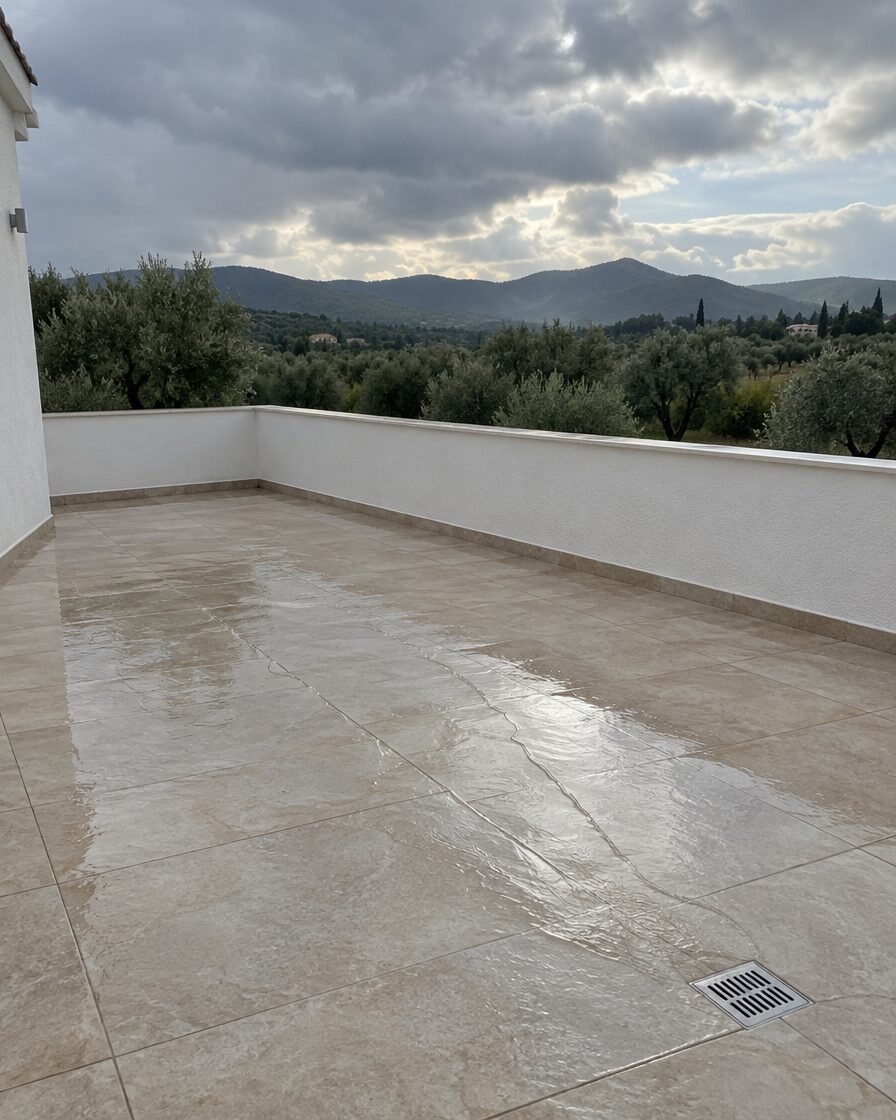
Run the arithmetic on your own plot. A modest 120m² of driveway and terrace sheds, in December alone, about 11,000 litres of water. Across December to February, roughly 29,000 litres. That water goes somewhere. The only question is whether you chose where, or whether gravity chose for you — usually towards the lowest point, which in a surprising number of villas here is the house.
The five ways hard landscaping fails here
It falls the wrong way. UK warranty standards want paths and drives to fall away from the building at a minimum of 1:80 — about 1.25% — and no steeper than 1:12. Level landings outside a door want 1:60 in one direction, away from the door. An approach route to a main entrance wants a crossfall of at least 1:40. These sound like fussy numbers. They are the difference between water leaving and water sitting.
It is laid too high. Paving should sit at least 150mm below the damp proof course. Here, terraces and driveways are frequently raised to meet a threshold flush, and the DPC is bridged. Every winter after that, the wall wicks.
The sub-base was never there. Block paving over 40mm of sand over compacted earth will look immaculate for one summer. Proper minimums: 75mm sub-base for a path, 100mm for a light domestic driveway, 150mm where anything heavier than a car will cross it — well-graded crushed stone or a weak ST1 concrete mix — with a 50mm sharp sand laying course under blocks, or a 25mm bed under slabs. When the rain comes, the undersized ones rut, dip and hold puddles exactly where cars turn.
There is no edge restraint. Blocks need something to push against. The standard detail is a 200×100mm precast edging bedded on an ST1 base 200mm wide and 100mm deep, haunched up the side. Without it, the edge courses migrate outwards, the joints open, and the pattern unzips from the outside in.
Water is discharged somewhere it shouldn't be. Rainwater should not discharge onto the highway. Gullies feeding a soakaway or a combined system need to be trapped. A drive that empties into the lane or over the boundary is both a neighbour problem and, in a December storm, a liability.
Retaining walls: the ones that actually hurt
Half the plots in Çatalköy, Bellapais, Esentepe and Lapta are terraced into a slope, which means retaining walls — and a failed retaining wall is a five-figure problem, not a cosmetic one.
The mechanism is simple and it is almost always water. Engineers designing against drained granular backfill work to an equivalent fluid pressure of roughly 4.7–9.4 kPa per metre of depth. Let that backfill saturate and the load climbs sharply: saturated clay weighs around 1,760–2,080 kg/m³ against 1,440–1,600 kg/m³ dry. The wall was never designed for the wet number. One engineering practice estimates — and they are clear it is an estimate from their own casework, not a measured statistic — that around 70% of the bowing and cracking complaints they attend trace back to drainage that was inadequate or has clogged.
What a wall that will survive here actually has behind it:
- A drainage zone of clean 20mm crushed stone, at least 300mm wide, running the full height of the wall
- Non-woven geotextile lining the excavation and wrapped over the top of the stone, so fines can't migrate in — contaminated or over-compacted aggregate can lose 30% or more of its drainage capacity
- A 100mm perforated pipe at the base, laid to a minimum 1% fall, discharging to a point you can actually find
- Weep holes of 50–100mm at 1.2–2.4m centres
- Backfill placed in 200–300mm lifts and compacted properly — but not over-compacted against the wall face
- Low-permeability soil or a surface swale capping the drainage zone near the top, so the surface water doesn't just pour straight down into it
Signs worth walking out to check this week: a wall bowing more than about 25mm over 1.2m of height needs looking at urgently. Also stepped cracking, a top course that has rotated forward, soil or staining pushing through joints, and the giveaway — a wall that stays wet for days after everything else has dried.
A walk round you can do this weekend
- Pour a bucket of water at the point where your terrace meets the house. Watch where it goes. If it hesitates or comes back, your fall is wrong.
- Find your DPC and measure down to the paving. Under 150mm is a flag.
- Stand on the drive and look for dips, rocking blocks and open joints at the edges — all sub-base and edge-restraint symptoms.
- Clear every gully, channel and outlet now. Dry summer debris is what blocks them in the first storm.
- Walk every retaining wall on the plot. Photograph any crack with a tape measure in shot, so you have a baseline to compare against in February.
- Find where your surface water is supposed to end up. If you can't, nobody designed it.
October and November — 81mm between them, across ten rainy days — are the last comfortable working window before December. Ground conditions are still good, materials cure properly, and it is far cheaper to lay a drive correctly now than to lift a failed one in January.
Where we fit
365 Build & Design builds driveways, block paving and landscaping, retaining walls and concrete works, terraces and waterproofing, with project management and property maintenance, across Kyrenia, Alsancak, Lapta, Esentepe, Çatalköy, Famagusta, Nicosia and İskele. We are NHBC certified, an officially registered TRNC company with 40 years of UK construction experience behind the work, a fully English-speaking team, and a 5-star Google rating.
We will tell you honestly when a drive needs lifting and when it only needs re-levelling and new edgings. One of those is a much smaller job, and we would rather you heard that from us than found out the expensive way.
Walk your plot this weekend. If something looks wrong, send us a photo. WhatsApp: https://wa.me/905428833240 Website: https://365builddesign.com/
Sources
- Cyprus Mail, 9 December 2025 — "North hit by severe floods — one dead" (night of 8–9 December 2025; Kioneli and Kanli reservoirs overflowed; flooding in northern Nicosia, Yenikent, Ayios Dhometios and the Nalbantoglu hospital road; landslides at Bellapais and Kazafani; Morphou cut off for several hours; one death, Ercin Fevzi, 57, found in his car near Alagadi beach; Kyrenia mayor Murat Senkul attributed the flooding to mountain runoff rather than urban drainage failure): https://cyprus-mail.com/2025/12/09/floods-hit-north-as-streams-overflow-and-roads-close
- Cyprus Mail, 2 October 2026 — "Rain affects highways across Cyprus" (heavy rain flooded sections of the Limassol–Paphos highway near Polemidia; rain on the Nicosia–Limassol and Larnaca–Ayia Napa highways; police warned drivers on distance and headlights): https://cyprus-mail.com/2026/10/02/rain-affects-highways-across-cyprus
- Weather2Travel — Kyrenia monthly climate averages (October 33mm/4 days, November 48mm/6 days, December 92mm/12 days, January 85mm/12 days, February 65mm/11 days; 441mm and 69 rainy days per year by sum of the published monthly figures): https://www.weather2travel.com/cyprus/kyrenia/climate/
- LABC Warranty Technical Manual v11, Section 14: Driveways and Paving (sub-base minimums 75mm path / 100mm light-duty drive / 150mm medium duty in well-graded crushed stone or ST1; 50mm sharp sand laying course for block paving, 25mm bed for slabs; falls away from the building minimum 1:80 and maximum 1:12; level landings 1:60; approach-route crossfall minimum 1:40; 200×100mm precast edgings on a 200mm × 100mm ST1 base with haunching; paving at least 150mm below DPC; rainwater not to discharge onto a highway; gullies to soakaway or combined system to be trapped): https://www.labcwarranty.co.uk/hubfs/Technical%20Manual%20V11%20-%20Thumbnails/Technical%20Manual%20V11%20-%20Section%20PDF%20Downloads/Section%2014%20Driveways%20and%20Paving.pdf
- ISTA Engineers — "Retaining Wall Drainage: The Detail That Prevents Failure" (equivalent fluid pressure of 30–60 psf per foot of depth for drained granular backfill; saturated clay 110–130 lb/ft³ against 90–100 lb/ft³ dry; drainage zone of 3/4in clean crushed stone minimum 12in wide for the full height of the stem; non-woven geotextile lining and wrapped over the top; 4in perforated pipe at minimum 1% slope; weep holes 2–4in at 4–8ft centres; backfill in 8–12in lifts compacted to 90–95% standard Proctor; contaminated or over-compacted aggregate losing 30%+ of drainage capacity; author's estimate that around 70% of bowing and cracking complaints they evaluate trace to drainage; bowing beyond roughly 1in per 4ft of height as an urgent threshold): https://istaengineers.com/retaining-wall-drainage/
Note on units: the ISTA figures are published in imperial and have been converted for this article — 30–60 psf/ft ≈ 4.7–9.4 kPa per metre; 110–130 lb/ft³ ≈ 1,760–2,080 kg/m³; 90–100 lb/ft³ ≈ 1,440–1,600 kg/m³; 12in ≈ 300mm; 3/4in ≈ 20mm; 4in ≈ 100mm; 2–4in ≈ 50–100mm; 4–8ft ≈ 1.2–2.4m; 8–12in ≈ 200–300mm; 1in per 4ft ≈ 25mm per 1.2m.
Note on the litre figures: 11,000 and 29,000 litres are straightforward arithmetic on the published rainfall figures (120m² × 92mm = 11.04m³; 120m² × 242mm = 29.04m³), assuming full runoff from an impermeable surface. They are illustrative of scale, not a drainage calculation for any specific property.