Most owners check their roof for leaks. Far fewer ask the question that matters before a winter storm: what, exactly, is holding the tiles on?
It sounds like a builder's question, and it is. But the answer decides whether a gust takes a handful of tiles off the ridge in January, drops them onto a terrace or a car, and leaves a hole for the next downpour.
The assumption that causes the damage
Wienerberger, one of Europe's large roof-tile manufacturers, published a UK guidance page in April 2026 on tile fixing. It names the cause of many failures directly: "the assumption that the weight of a tile alone is enough to keep it in place". The page calls that assumption untrue. Tiles that are not adequately fixed, it says, "can become dislodged, posing a serious risk to property – and, more importantly, to people below".
Wind does not simply push on a roof. It flows over it and lifts. A tile resting on battens or on a mortar bed has only gravity and friction to resist that lift.
What UK guidance expects (and why it is worth knowing)
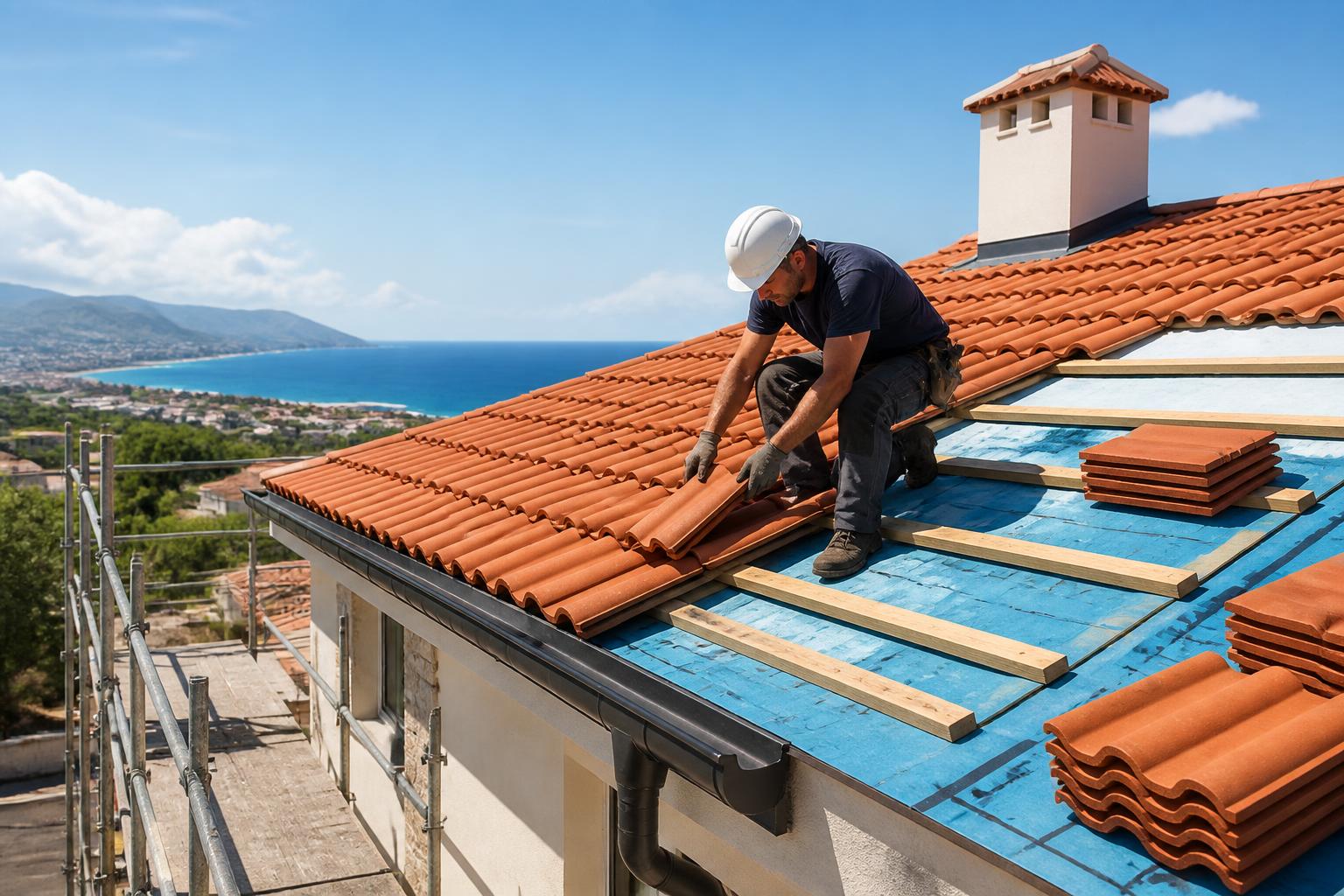
The British standard for tiling and slating, BS 5534, was strengthened in its 2014 revision, informed by the Eurocodes. According to Wienerberger, roof tiles must be fixed to a site-specific fixing specification, and every single-lap tile needs at least one mechanical fixing, meaning a nail, a clip or both.
The inputs to that specification are worth reading, because none of them is "a standard villa": tile type and format, roof geometry and pitch, building height, geographic location, and altitude and local wind exposure. Wienerberger adds that fixing specifications "always represent the minimum standard".
Marley, another UK manufacturer, gives examples of the minimums. On pitches of 45° and above, single-lap tiles need at least one nail each; at 55° and above, the tail of each tile must be fixed mechanically. Hips and ridges need a minimum of two mechanical fixings, and the strength of the mortar bedding is not counted when wind uplift is calculated.
That last point matters in Cyprus, where mortar-bedded ridge and hip tiles are a familiar sight.
Three honest caveats. This is a UK standard, not a TRNC building code, and we have not seen a North Cyprus equivalent. Both manufacturers sell fixings, so they have a commercial interest. And their wording differs on detail, which is exactly why the specification for your roof has to come from the tile product and the site itself, not from a rule of thumb.
What a North Cyprus study flagged
A 2015 MSc thesis from Eastern Mediterranean University, Roof Defects in North Cyprus by Shadi Pakpour Aghghaleh, looked at roofs in Nicosia, Famagusta, Kyrenia and İskele. Its owner survey drew on 2,064 private buildings completed in 2009 and questioned 326 owners five to six years after they moved in. The abstract says the building boom after the Annan Plan produced many low-cost, low-quality buildings, with defects appearing a few years after construction.
The causes it groups under three headings read like a pre-winter checklist:
- Poor design: missing details, inadequate insulation, and flat roofs drained with the wrong slope.
- Poor workmanship: cockles, ridges and splits in roofing membranes, poor levelling, and slipped or loose tiles.
- Maintenance: mould on roof tiles, items placed on the roof, and broken or blocked gutters.
We could read the abstract and the early chapters but not the findings chapters, so we are not quoting any defect percentages. The thesis is also a decade old. Treat it as a useful list of what goes wrong, not a current statistic.
A pre-winter check you can do without climbing
Please do not walk on a tiled roof. Tiles crack underfoot and falls are serious. Most of this can be done from the ground, a terrace or the loft.
- Look along the roof with binoculars. Slipped, cracked or missing tiles show as gaps or uneven lines.
- Check the ridge and hips. Cracked or crumbling mortar, or ridge tiles that no longer sit in a straight line, are an early warning.
- Look at gutters and downpipes. Blocked or broken gutters send water where it should not go, and the thesis lists them under maintenance.
- Note anything attached to the roof. Aerials, dishes, solar frames, water-heater supports: ask who fitted them and how the fixings were sealed.
- Look for moss or mould on the tiles. It holds moisture against the surface.
- Go into the loft with a torch on a bright day. Daylight where there should be none, damp timber, or stained underlay all mean a closer look.
- Check ceilings after rain for new stains, especially under ridges, valleys and chimneys.
- Walk the garden after a blow. Fragments of tile or ridge are evidence.
Repair, re-fix or re-roof?
A few cracked tiles can be replaced individually. A ridge with failing mortar is better re-bedded and mechanically fixed than patched. If tiles on a whole slope are loose, the honest answer is often to open a section and see what is actually holding them. On older villas the original fixing method is frequently unknown, and nobody should guess.
Whoever you ask, ask four things: what are the tiles fixed with and how many per tile, how are the ridges and hips fixed, what condition is the underlay in, and can the scope be written down before work starts.
How 365 Build & Design can help
We would rather look at a roof and tell you plainly what it needs than sell you a new one. We can inspect a roof, repair tiles, re-bed and fix ridges, install gutters, and deal with waterproofing, and we will put the scope in writing first. If something is outside what we do, we will say so.
365 Build & Design is NHBC certified and an officially registered TRNC company based in Kyrenia, with a fully English-speaking team and a 5-star Google rating. We work across Kyrenia, Alsancak, Lapta, Esentepe, Famagusta, İskele and Nicosia.
Talk to 365 Build & Design about your project.
WhatsApp: https://wa.me/905428833240 Website: https://365builddesign.com/
Sources
- Wienerberger Ltd, "Roof tile fixing: why getting it right really matters" (April 2026): https://www.wienerberger.co.uk/tips-and-advice/roofing/roof-tile-fixing-why-getting-it-right-really-matters.html
- Marley, "What are the fixing requirements of BS 5534?": https://cm.marley.co.uk/blog/what-are-the-fixing-requirements-of-bs-5534
- Eastern Mediterranean University, S. Pakpour Aghghaleh, "Roof Defects in North Cyprus", MSc thesis, 2015: https://i-rep.emu.edu.tr/items/5ce056cf-d0a1-4a09-a21f-a0c4007ef88e