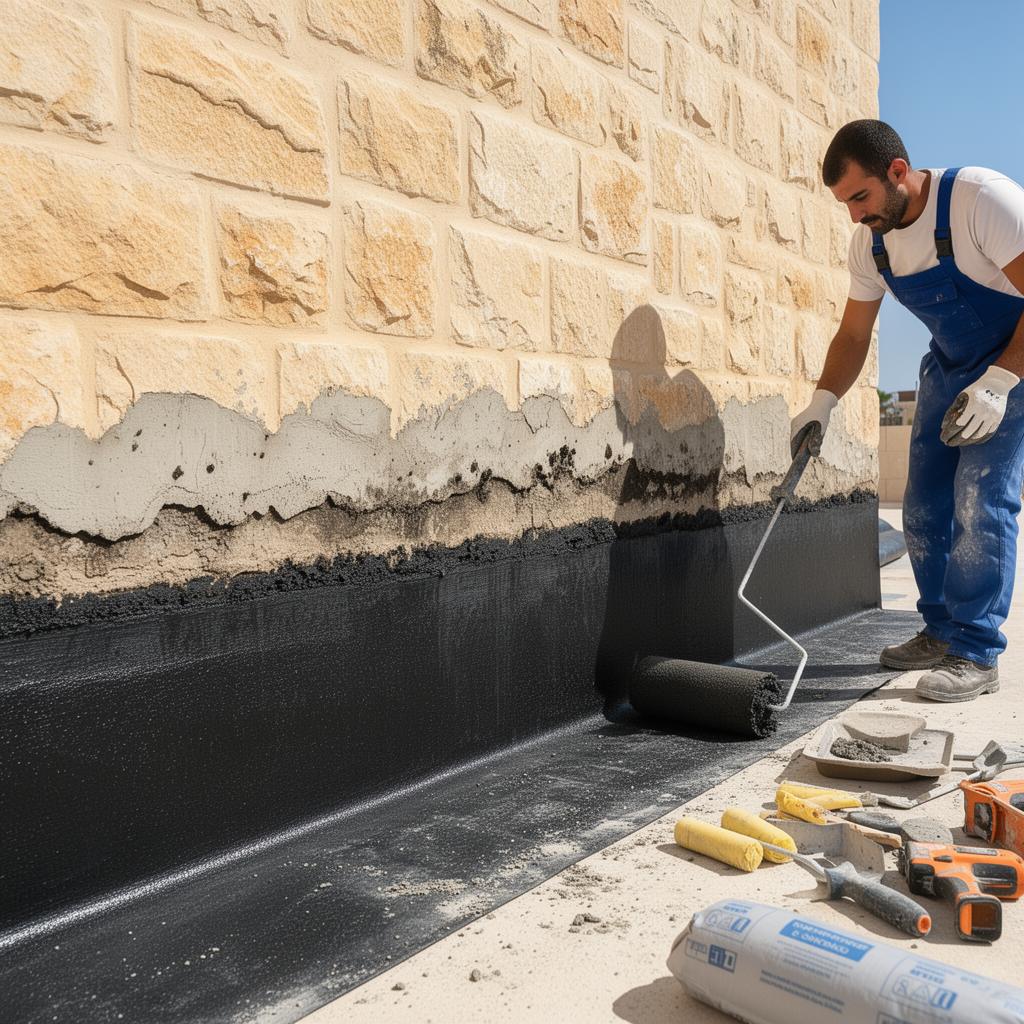
Every winter the same photograph lands in a builder's inbox: a pale tide mark along the foot of a ground-floor wall, paint blistering above it, a skirting board that has started to swell. The owner has usually already decided what it is. Rising damp. And the next step, quite often, is a quote for a treatment.
The trouble is that the diagnosis is frequently wrong. Tim Hutton, a UK building pathologist writing for the Building Conservation Directory, says rising damp is "widely misdiagnosed in existing buildings, based on the incorrect interpretation of visual evidence and the readings of moisture meters." His article is UK-focused and was revised in 2012, so it is not a study of Cyprus. But the physics of water in walls does not change at the border, and the questions it raises are exactly the ones to ask in a Kyrenia villa in November.
What rising damp actually is
Rising damp is capillary action: moisture drawn upwards through porous building materials. According to the Designing Buildings Wiki summary of BRE Digest 245, a porous wall standing in water or saturated soil with no damp-proof course (DPC) can show rising damp to a height of more than one metre. The same summary says that where a physical DPC exists it is "unlikely that it has failed, as most dpc materials have a long life", but that it can be bridged, for example by mortar droppings in a cavity wall. It also warns that high readings from a moisture meter alone "are not conclusive", because some salt accumulation occurs in old walls with no damp problem.
So the real question is rarely "is the wall damp?" It is "where is the water coming from?"
Why a Kyrenia winter tests every wall
Long-term averages published by weather2travel (the page does not state the years covered) put Kyrenia's rainfall at 48 mm in November across 6 rainy days, 92 mm in December across 12, 85 mm in January across 12 and 65 mm in February across 11. By our own addition, December to February comes to 242 mm. It arrives in bursts, and the bursts are what find the weak points.
The recent record shows how local conditions can be. Cyprus Mail reported on 9 December 2025 that severe floods hit swathes of the north, with homes and businesses under water and landslides in the Bellapais and Kazafani area. On 25 January 2026, Cyprus FAQ, a consumer news site, reported flooding in Kyrenia, Gönyeli, Famagusta and elsewhere, including the basements of two apartment buildings in Famagusta's Karakol area. It quoted Kyrenia's mayor, Murat Şenkul, as saying the problem was worsened because natural drainage channels had been built over with residential buildings. (Cyprus FAQ says its articles are created with AI assistance, so we treat it as a pointer rather than an authority.)
Water that has nowhere sensible to go ends up at your walls.
The usual suspects, before rising damp
-
Drainage and surface water. Hutton calls "defective ground and surface drainage" the most common source of moisture in the base of walls. Downpipes that discharge at the wall, blocked gullies and a terrace that falls towards the house all qualify.
-
Ground built up against the wall. Historic England notes that external levels can build up over the years until they sit higher than the internal floor or DPC, giving moisture "routes through the walls or floors that were not originally possible." New paving, planting beds and a raised patio can do the same job in a few weeks.
-
Leaking plumbing. Hutton lists chronic plumbing leaks as a source of "moisture reservoirs" in foundations. A weeping pipe in a floor slab can look just like damp rising from the ground.
-
Condensation. He says damp at the base of walls may be "greatly increased by condensation", particularly in intermittently heated ground-floor rooms. A villa left shut up between visits is exactly that.
-
Salts that stay behind. A salt tide mark is "often taken as a typical diagnostic feature" of rising damp, but he notes it can remain "even when the water penetration that originally caused them has long gone." Salts can also absorb moisture from the air, especially above 75 per cent relative humidity, which gives the appearance of damp that is not actually rising.
-
Impermeable finishes. He identifies sand/cement renders at the foot of external walls as "a common cause of damp problems" because they stop moisture evaporating. Historic England makes a similar point about cement mortars in older buildings. Both sources are about traditional UK masonry. Many North Cyprus villas are concrete-frame with block infill, so how this applies depends on the wall build-up, which is a reason to look rather than assume.
A practical check you can do this week
- Photograph and date the damp. Note its height and whether it is patchy or continuous.
- Walk the outside, in the rain if you can. Where do downpipes and gullies discharge? Does water pool against the wall?
- Compare levels. Is the paving or soil outside higher than the floor inside, or close to it?
- Check for plumbing. Is the water meter moving when everything is off?
- Watch the pattern. Worse after rain points to external water; worse on cold, still mornings in an unheated room points to condensation.
- Ventilate, then re-check. Hutton's own advice is to re-establish ventilation "not to start applying further damp-proof materials".
- Don't paint over it. You will hide the evidence and trap the moisture.
- Ask for the diagnosis in writing before agreeing to any treatment.
When to call someone
If the damp keeps returning, if there is a smell, or if the plaster is blowing, get it looked at. Hutton also cautions that injected chemical DPCs may be "wrongly specified and ineffective", and that water-based hydrophobic products may only work if applied to a dry wall. That is his view and the evidence he cites is not in the article, but it is a good reason to get the cause confirmed before anyone drills a wall.
What we cannot tell you
We cannot say from a photograph whether your damp is rising damp, and nobody honestly can. Whether your villa has a DPC depends on its age and builder. The sources above are from the UK, and none is specific to North Cyprus. The rainfall figures are long-term averages from a travel-weather site.
How 365 Build & Design can help
We start with the cause: external levels, drainage, gutters and downpipes, plumbing, ventilation and the wall finish. Where work is needed, we can quote in writing for waterproofing, plastering, painting and decorating, plumbing, gutter installation, driveways and block paving, and retaining walls. 365 Build & Design is NHBC certified and an officially registered TRNC company based in Kyrenia, with a fully English-speaking team and a 5-star Google rating. We work across Kyrenia, Alsancak, Lapta, Esentepe, Famagusta, İskele and Nicosia. If something is beyond us, we will say so.
Talk to 365 Build & Design about your project.
WhatsApp: https://wa.me/905428833240
Website: https://365builddesign.com/
Based in Kyrenia · Serving North Cyprus · NHBC certified · Fully English-speaking team · Officially registered TRNC company · 5-star rated on Google