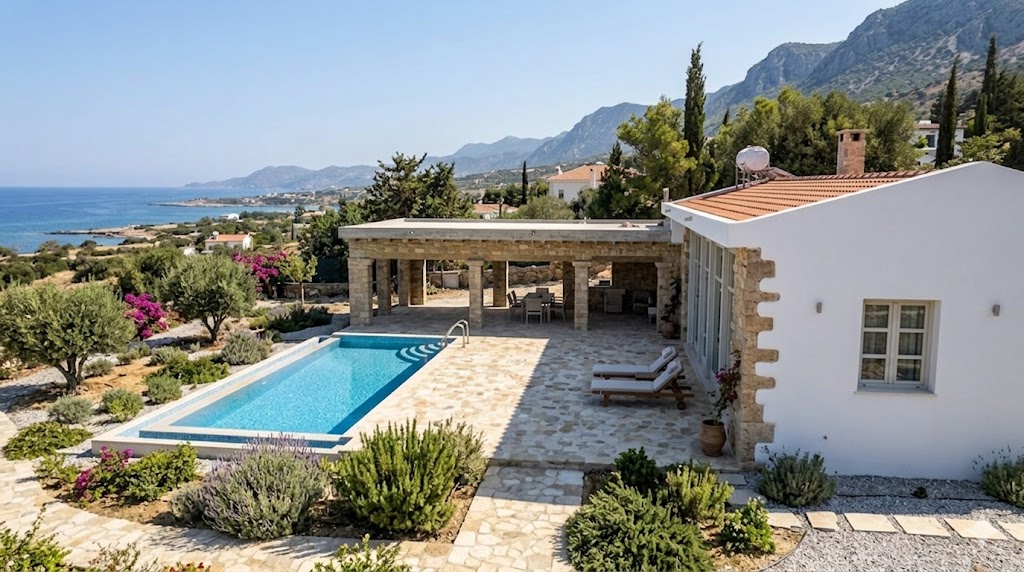
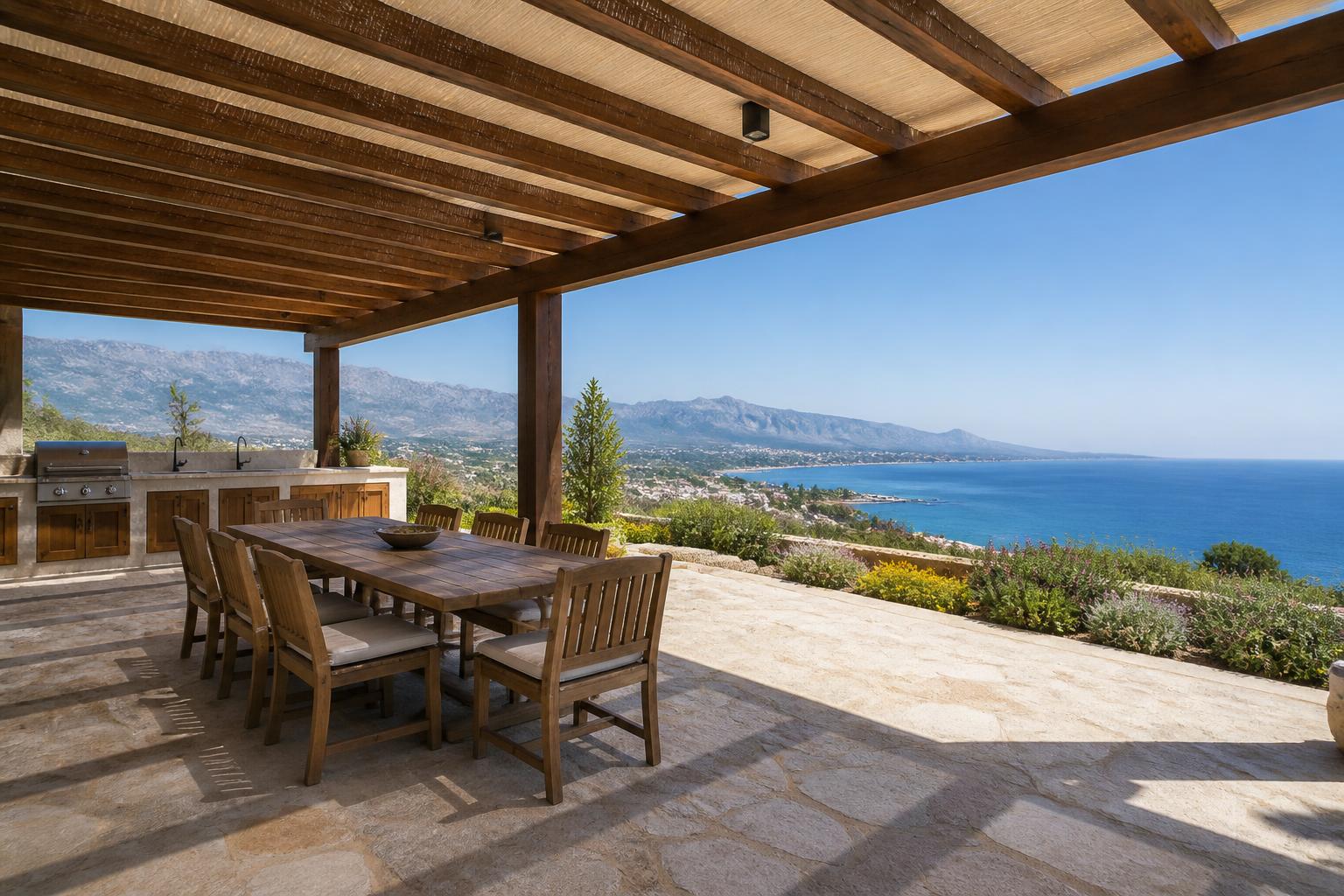
A pergola looks its best on a July evening, with a glass in hand and the Kyrenia range turning pink behind it. It does its real work in November, when a low pressure system parks over the island and the wind arrives from a direction the designer never thought about.
If you are planning a pergola, a glass room or an outdoor kitchen terrace this winter, or you already have one, this is the season to look at it properly.
What the storm record actually shows
We checked recent North Cyprus reports rather than guess. They are a reminder that wind is part of the climate here, not a freak event.
On 28 October this year, the Cyprus Mail reported a yellow weather warning for severe storms, running from 2am to 6pm on the Wednesday. The forecast described winds of 3 to 4 Beaufort rising to 4 to 5, and "near gale to gale force" winds of 7 to 8 Beaufort in thunderstorm areas and along the coast on Wednesday night, with strong coastal winds continuing on Thursday. The article does not say whether the warning covered the north, so treat it as the island's weather rather than a TRNC-specific forecast.
On 29 August 2026, the TRNC's Civil Defence Organisation issued an orange warning for severe thunderstorms, heavy rain, hail and strong winds between 10am and 7pm, according to Haber Kenti. A tree came down in Güzelyurt, some billboards blew away around Lefkoşa and red flags flew on Girne's beaches.
On 30 January 2024, Politikam, citing the Anadolu Agency, reported trees and signs falling onto vehicles in Lefkoşa and Girne, power cuts in parts of Girne and a waterspout off İskele that lasted about 15 minutes.
And on 20 November 2020, T-Vine reported a tornado that came ashore around Girne and Güzelyurt, bringing down trees and power poles, flipping vehicles and ripping roofs off in places including Ozanköy, Çatalköy, Lapta and Karşıyaka. Three people were reported slightly hurt.
None of these reports says a pergola failed, and none gives a wind speed in km/h, so we will not claim either. The point is simpler: roofs, signs and trees do fail here, and a large, flat, light structure bolted onto a terrace is exactly the sort of object a strong gust looks for.
Where outdoor structures usually go wrong
Having built and repaired terraces and outdoor spaces, these are the weak points we look at first:
- The fixings. A structure is only as good as how it is attached to the ground or the wall. Post bases fixed to a thin screed, or a few small anchors into tired concrete, are the classic failure.
- Solid sides. Homebuilding magazine notes that open-style pergolas are relatively unlikely to blow away, while side-panelled ones may be more prone to catching the wind. Add blinds, screens or glass and you have turned a frame into a sail.
- Freestanding versus wall-fixed. One European manufacturer's guidance points out that a wall-mounted pergola is more stable than a freestanding one, provided the wall itself is sound.
- Roof panels and louvres. Adjustable slats let wind through, but they also need to be closed or angled correctly. One manufacturer advises opening louvres to around 45 degrees in high wind. That is product-specific advice, so ask for your own system's storm instructions in writing.
- Water. Louvred roofs collect water into channels, and channels block with leaves and grit, then overflow. It is the same debris problem we see in gutters.
- Corrosion. Coastal air eats cheap fixings. Hot-dip galvanised or stainless fasteners, as Homebuilding recommends, matter more in Kyrenia than they would inland.
Fixing it properly: principles, not magic numbers
You will find online advice quoting footing sizes and "storm-force" ratings. Treat those with care. Informal footing dimensions in magazines are written for UK gardens, and one UK retailer we looked at quotes a km/h rating without naming the test standard behind it. A number is only useful if you know what it was tested against.
What matters in North Cyprus:
- Know the ground. Is it solid rock, compacted fill, a terrace slab or a thin screed over a void? The fixing detail depends on the answer.
- Fix into structure. Posts need a foundation or a base that is part of the structure, not a surface finish.
- Match fixings to the environment. Corrosion-resistant fasteners, correctly sized, installed to the manufacturer's detail.
- Allow for the roof and the sides. A solid roof, a polycarbonate roof, a louvred roof and a glass room all load the frame differently.
- Plan the water. Where does the roof drain, and where does that water go afterwards?
- Re-check. Bolts settle. Homebuilding's experts suggest re-tightening after a few weeks, and manufacturers recommend yearly checks and a check after every storm.
Questions to ask before you buy
- How is it fixed, into what, and who designed that detail?
- What wind rating is claimed, to which test standard, and by whom?
- What do I do to the roof, blinds and screens when a storm warning is issued?
- Where does the roof water go, and who clears the channels?
- What are the fixings made of?
- Does it need a permit or approval here, and who handles that?
- Who do I call in January if something moves?
- Can all of this be explained, and written down, in English?
A November check for existing structures
- Push each post and look for movement at the base.
- Look for rust streaks or white salt bloom around fixings.
- Tighten loose bolts and replace any that are rusting.
- Clear roof channels and outlets.
- Close, lower or remove blinds and loose cushions before a warning.
- Look for cracks in the slab or render where the structure meets the house.
- If the villa will be empty, ask someone to check after the first heavy storm.
Permits and neighbours
Whether a pergola or glass room needs approval in the TRNC depends on its size, how it is attached to the house and how it will be used. UK planning rules in the sources we read do not apply here. Please check before building. When in doubt, ask.
How we approach it
At 365 Build & Design we design and build pergolas, glass rooms and outdoor living spaces, and we treat them as structures, not furniture. We bring 40 years of UK construction experience and NHBC-certified practice to every project, and we are an officially registered TRNC company based in Kyrenia. We look at the ground, the fixings and the water before we talk about the finish, and our whole team speaks English, so you will always know exactly what is being fixed to what.
Whether you are in Kyrenia, Alsancak, Lapta, Esentepe, Famagusta, İskele or Nicosia, the same principle holds: a good outdoor space is one you stop worrying about the first time the weather turns.
Thinking about a pergola or glass room, or worried about the one you have? Talk to 365 Build & Design about your project.
WhatsApp: https://wa.me/905428833240 Website: https://365builddesign.com/ Based in Kyrenia · Serving North Cyprus · Fully English-speaking team · NHBC certified · 5-star rated on Google